

Flare Gas Recovery System Market to Witness Remarkable Growth, Projected to Reach US$ 3.3 Billion by 2032
Flare Gas Recovery System Market
Asia-Pacific leads the global flare gas recovery system market by 35% of share in 2025, recording the fastest growth at 6.8% CAGR
LONDON, LONDON, UNITED KINGDOM, February 17, 2026 /EINPresswire.com/ -- The global flare gas recovery system market is poised for sustained growth as environmental mandates and operational efficiency goals reshape the oil & gas and petrochemical landscape. According to the latest study by Persistence Market Research, the global flare gas recovery system market size is likely to be valued at US$ 2.4 billion in 2025 and is projected to reach US$ 3.3 billion by 2032, growing at a CAGR of 5.2% between 2025 and 2032. The market demonstrated steady historical expansion from US$ 1.8 billion in 2019, reflecting a CAGR of 3.5%. This growth trajectory is primarily driven by stringent environmental regulations targeting methane emissions reduction and increasing emphasis on sustainable hydrocarbon management.
Get Your FREE Sample Report Instantly – Click Now: https://www.persistencemarketresearch.com/samples/12916
Stringent Methane Emission Regulations Accelerating Adoption
Governments and regulatory bodies worldwide are intensifying efforts to curb methane emissions due to their high global warming potential. Oil & gas operators are under mounting pressure to minimize routine flaring and reduce greenhouse gas footprints. Flare gas recovery systems (FGRS) provide a practical solution by capturing waste gases and redirecting them for productive use, thereby aligning industrial operations with environmental compliance standards and ESG commitments.
Growing Focus on Operational Efficiency and Cost Optimization
Beyond environmental compliance, flare gas recovery systems are gaining traction for their economic benefits. By recovering and reutilizing flare gas, companies can significantly reduce fuel losses and improve plant efficiency. Captured gas can be reused for power generation, reinjection, or as feedstock in petrochemical processes, helping companies enhance profitability while reducing carbon emissions.
Rising Investments in Oil & Gas Infrastructure
Expansion of upstream and downstream oil & gas activities, particularly in emerging economies, is supporting the steady demand for flare gas recovery technologies. Onshore and offshore production facilities are integrating FGRS solutions during new installations as well as retrofitting existing infrastructure. This trend is strengthening market prospects across mature and developing hydrocarbon markets.
Technological Advancements Enhancing System Performance
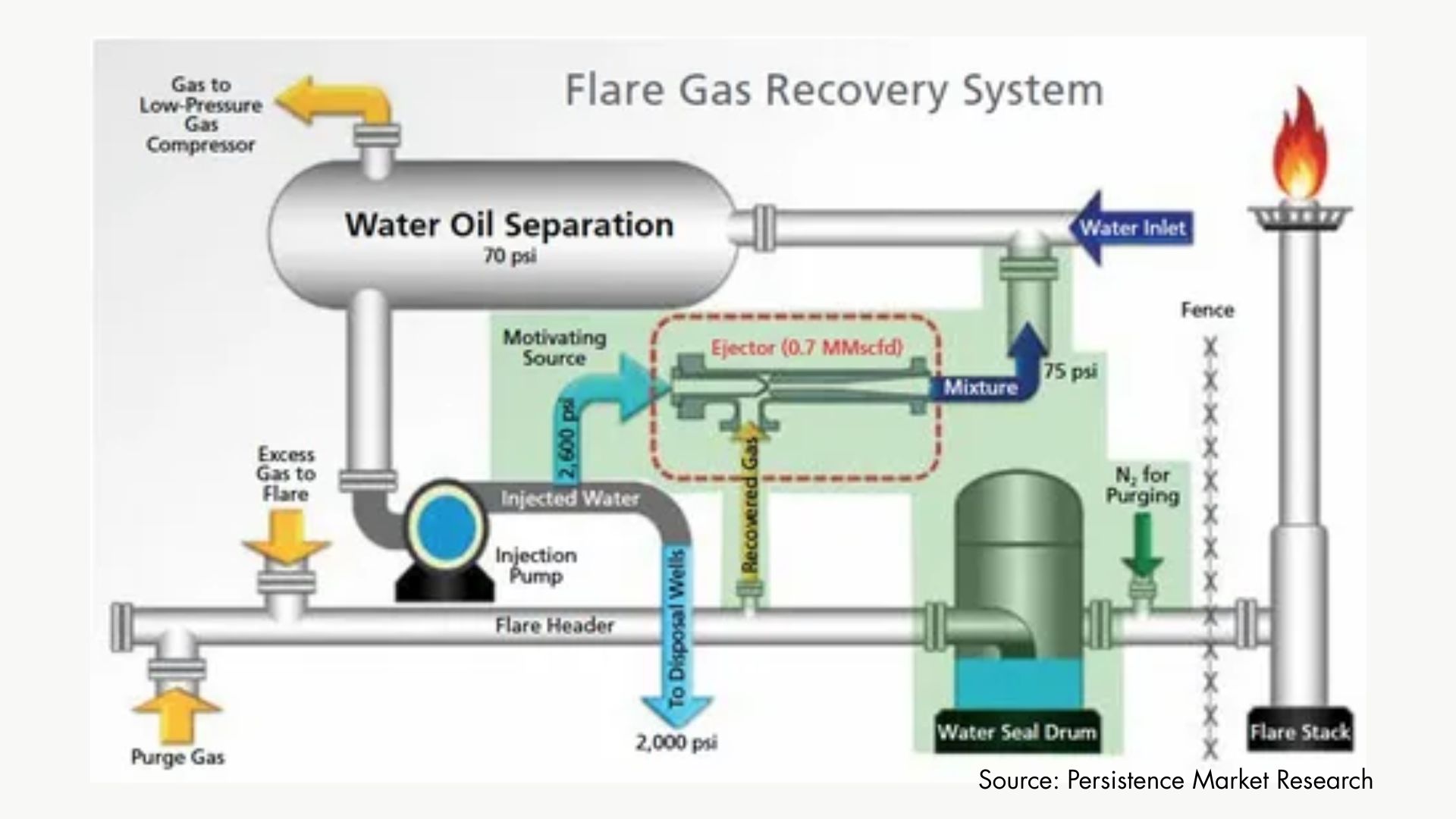
Continuous innovation in compressor-based and ejector-based systems is improving system reliability, efficiency, and adaptability across varying pressure conditions. Advanced monitoring systems and automation technologies are enabling real-time performance optimization and predictive maintenance, reducing downtime and improving return on investment. Modular designs are also facilitating easier installation in space-constrained offshore platforms.
Increasing Adoption in Petrochemical and Chemical Sectors
While oil & gas remains the primary end-user, petrochemical and chemical industries are increasingly deploying flare gas recovery systems to minimize hydrocarbon loss and enhance sustainability metrics. As global demand for chemicals rises, companies are focusing on integrating emission-reduction technologies into production cycles to meet regulatory and investor expectations.
Get a Customized Market View in One Click: https://www.persistencemarketresearch.com/request-customization/12916
Offshore Installations Gaining Momentum
Offshore oil production activities, especially in regions such as the Middle East and parts of Asia Pacific, are witnessing higher adoption of compact and efficient FGRS solutions. Offshore facilities face stricter environmental monitoring and logistical challenges, making flare gas recovery systems an essential component for reducing flaring volumes and maintaining compliance.
Regional Outlook Highlighting Emerging Opportunities
North America continues to hold a prominent position in the flare gas recovery system market due to strong regulatory enforcement and established oil & gas infrastructure. Europe is advancing steadily, supported by climate-focused industrial policies. Asia Pacific is emerging as a high-potential region owing to expanding refinery capacity and energy demand. Meanwhile, Latin America and the Middle East & Africa are experiencing increased adoption driven by hydrocarbon production growth and regulatory modernization.
Integration with Digital Monitoring and Automation
The integration of digital technologies, including IoT-enabled sensors and data analytics platforms, is transforming flare gas recovery operations. Smart monitoring systems help detect inefficiencies, manage variable gas flows, and ensure optimal performance under fluctuating pressure conditions. This digital shift is enhancing safety, operational transparency, and regulatory reporting capabilities.
Market Segmentation
By Technology Type
• Compressor-Based Systems
• Ejector-Based Systems
By Pressure Type
• Upto 5 Bar
• 6 to 10 Bar
• 11 to 15 Bar
• 16 to 20 Bar
• Above 20 Bar
By End-user
• Oil & Gas
• Petrochemical & Chemical
• Power Generation
• Others
By Installation
• Onshore
• Offshore
By Region
• North America
• Europe
• Asia Pacific
• Latin America
• Middle East & Africa
Competitive Analysis
The flare gas recovery system market is moderately consolidated, with key players focusing on technological innovation, strategic partnerships, and global expansion to strengthen their market position. Companies are investing in advanced compressor technologies, digital integration capabilities, and customized system designs to address diverse operational requirements. Strategic contracts with national oil companies and large-scale EPC projects are shaping competitive dynamics.
For In-Depth Competitive Analysis, Buy Now: https://www.persistencemarketresearch.com/checkout/12916
Company Insights
Leading companies operating in the global flare gas recovery system market include:
✦ Zeeco, Inc.
✦ John Zink Hamworthy
✦ Wood Group
✦ Honeywell International Inc.
✦ Baker Hughes
✦ ABB Ltd.
✦ Siemens Energy
✦ Schlumberger Limited
✦ Sulzer Ltd.
✦ KBR, Inc.
✦ TechnipFMC
✦ McDermott International
Outlook: Steady Growth Amid Sustainability Transition
The flare gas recovery system market is positioned for stable growth through 2032, underpinned by environmental mandates and economic incentives to reduce flaring. With a projected valuation of US$ 3.3 billion and a CAGR of 5.2% from 2025 to 2032, the market reflects a balanced trajectory driven by regulatory compliance and operational optimization. As energy companies continue their transition toward lower-emission operations, flare gas recovery systems will remain an essential technology in achieving both environmental sustainability and resource efficiency goals.
Explore the Latest Trending Research Reports:
• Biodiesel Market
• Mining Robotics Market
About Persistence Market Research:
Persistence Market Research delivers strategic research solutions that drive business growth. Founded in 2012 and registered in England and Wales in 2023 as Persistence Research & Consultancy Services Ltd., we have completed 3,600+ custom and syndicated studies and supported 2,700+ projects for leading research firms. Combining traditional methodologies with modern tools, we provide actionable insights to multinational corporations, consultants, investors, and government bodies, earning strong trust through long-term client relationships.
Ajaykumar Patil
Persistence Market Research
+1 6468786329
email us here
Visit us on social media:
LinkedIn
Instagram
Facebook
YouTube
X
Legal Disclaimer:
EIN Presswire provides this news content "as is" without warranty of any kind. We do not accept any responsibility or liability for the accuracy, content, images, videos, licenses, completeness, legality, or reliability of the information contained in this article. If you have any complaints or copyright issues related to this article, kindly contact the author above.
