
Basalt Rock Market to Hit USD 4.43 Billion by 2036,Asia Pacific Leads with Technobasalt, Basaltex & Mafic Driving Growth
basalt rock market
Basalt rock market set to reach USD 4.43B by 2036, driven by infrastructure growth, basalt fiber demand, and sustainable materials adoption globally.
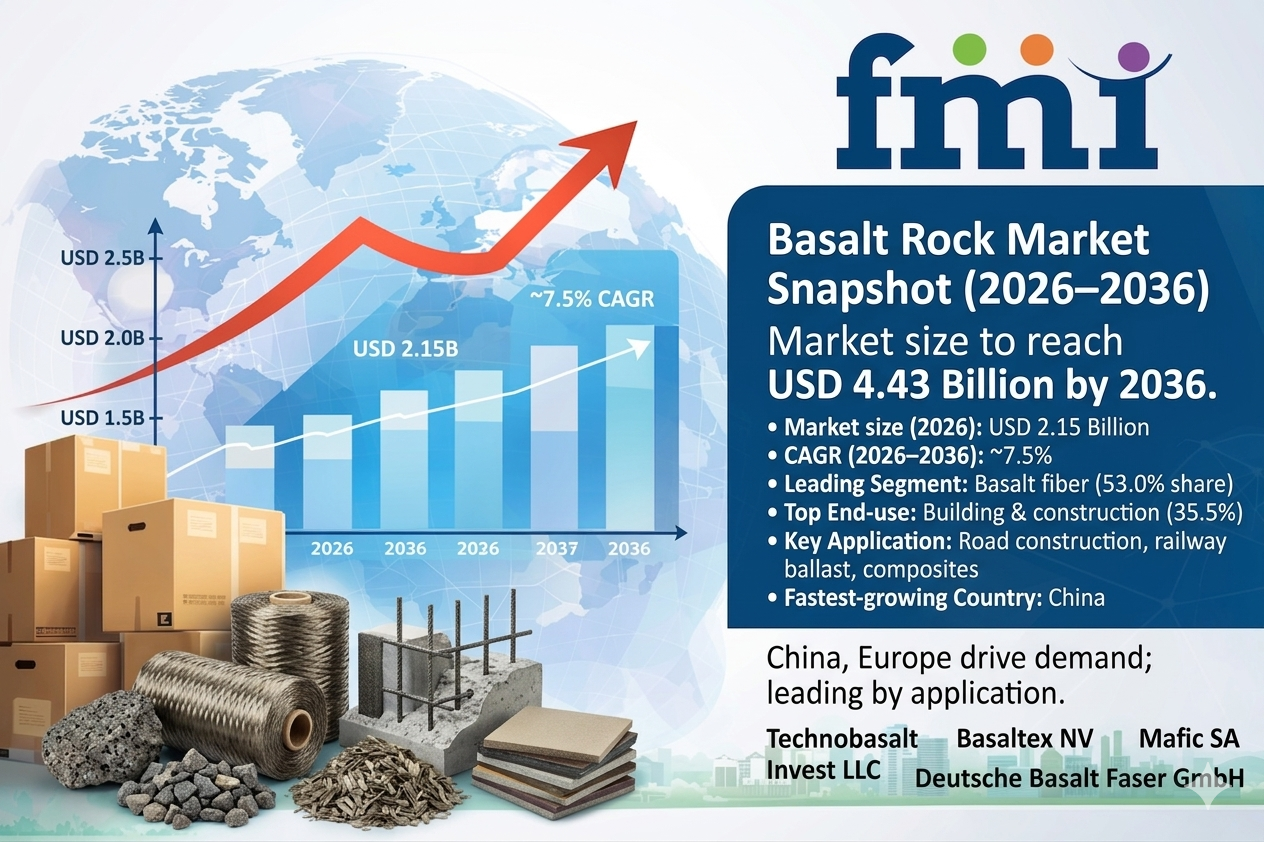
NEWARK, DE, UNITED STATES, April 3, 2026 /EINPresswire.com/ -- The global basalt rock market is valued at USD 2.15 billion in 2026 and is projected to reach USD 4.43 billion by 2036, expanding at a CAGR of 7.5% from 2026 to 2036. Growth is fueled by large-scale infrastructure development, increasing adoption of durable construction materials, and rising demand for basalt fiber in advanced industrial applications.
As global industries shift toward sustainable and high-performance materials, basalt rock is emerging as a strategic resource across construction, composites, and industrial manufacturing. Its superior mechanical strength, corrosion resistance, and eco-friendly properties position it as a preferred alternative to traditional materials such as limestone and synthetic fibers.
Basalt Rock Market Snapshot (2026–2036)
• Market size in 2026: USD 2.15 billion
• Market size in 2036: USD 4.43 billion
• CAGR (2026–2036): ~7.5%
• Leading segment: Basalt fiber (53.0% share)
• Top end-use segment: Building & construction (35.5%)
• Key application: Road construction, railway ballast, composites
• Fastest-growing country: China
• Key companies: Technobasalt Invest LLC, Basaltex NV, Mafic SA, Deutsche Basalt Faser GmbH
Market Momentum
The basalt rock market begins at USD 2.15 billion in 2026, supported by strong demand from road construction, railway ballast, and concrete aggregate applications across emerging economies. Between 2027 and 2030, expansion in basalt fiber production capacity accelerates demand for high-quality basalt feedstock, creating a high-value secondary revenue stream for quarry operators.
Entering 2032 and beyond, technological advancements in fiber processing, increasing adoption in automotive and aerospace composites, and expansion of sustainable construction practices reinforce market growth. By 2036, the market reaches USD 4.43 billion, driven by widespread application across infrastructure, marine engineering, and industrial sectors.
Request For Sample Report | Customize Report | Purchase Full Report
https://www.futuremarketinsights.com/reports/sample/rep-gb-26079
Why the Market is Growing
The basalt rock market is expanding as industries prioritize materials that offer durability, sustainability, and cost efficiency. Basalt’s natural strength, thermal stability, and resistance to chemical corrosion make it highly suitable for infrastructure and industrial applications.
A key growth driver is the rapid expansion of basalt fiber manufacturing, which transforms raw basalt into high-performance composite materials used in automotive, aerospace, and energy sectors. Basalt fiber offers a sustainable alternative to glass and carbon fibers, combining cost-effectiveness with superior mechanical properties.
Additionally, infrastructure projects in Asia Pacific and Europe increasingly specify basalt aggregates due to their abrasion resistance and long lifecycle performance, reducing maintenance costs in high-traffic environments. Environmental sustainability trends further enhance market adoption, as basalt requires minimal processing and aligns with green building standards.
Segment Spotlight
1. Product Type: Basalt Fiber Leads Market Share
Basalt fiber accounts for approximately 53.0% of the market, driven by its increasing use in composite materials across automotive, construction, and aerospace industries. Its high strength and corrosion resistance make it a preferred reinforcement material.
2. End-Use Industry: Building & Construction Dominates
Building and construction hold around 35.5% market share, supported by rising infrastructure development, urbanization, and demand for durable construction materials globally.
3. Application: Infrastructure & Transport Drives Demand
Applications such as road construction, railway ballast, and marine engineering dominate demand, where basalt’s durability and load-bearing capacity provide long-term performance advantages.
Drivers, Opportunities, Trends, Challenges
• Drivers: Infrastructure expansion, basalt fiber demand, sustainable construction materials
• Opportunities: Advanced composites, green building adoption, fiber-grade basalt premium pricing
• Trends: Shift toward basalt fiber applications, mineral sorting technologies, eco-friendly materials
• Challenges: Environmental permitting constraints, mineral composition variability, competition from synthetic materials
Country Growth Outlook (2026–2036)
China leads the market with a CAGR of 10.1%, driven by massive infrastructure development and basalt fiber production expansion. India follows at 9.3%, supported by rapid urbanization and government infrastructure initiatives.
Germany (8.6%) and France (7.9%) show strong growth due to sustainable construction practices and composite material adoption, while the UK (7.1%) maintains steady expansion through infrastructure modernization. The United States records 6.4% CAGR driven by infrastructure renewal, and Brazil grows at 5.6% with increasing construction demand and resource development.
Competitive Landscape
The basalt rock market features a mix of quarry operators, fiber manufacturers, and integrated material companies competing on quality, processing capabilities, and innovation. Companies are investing in mineral composition testing, fiber-grade segregation, and advanced production technologies to enhance product performance.
Key players such as Technobasalt Invest LLC, Basaltex NV, Mafic SA, and Deutsche Basalt Faser GmbH are focusing on expanding basalt fiber production, improving material consistency, and strengthening global distribution networks. Competitive advantage increasingly depends on the ability to supply both construction-grade and fiber-grade basalt, enabling dual revenue streams.
Frequently Asked Questions (FAQ)
What is the global basalt rock market size?
The market is valued at USD 2.15 billion in 2026 and is projected to reach USD 4.43 billion by 2036.
At what rate is the market expected to grow?
The market is forecast to expand at a CAGR of approximately 7.5% from 2026 to 2036.
What is basalt rock used for?
Basalt rock is used in construction aggregates, basalt fiber production, marine engineering, and industrial applications due to its strength and durability.
Why is basalt fiber gaining popularity?
It offers a sustainable, cost-effective alternative to glass and carbon fibers with excellent mechanical and thermal properties.
Explore More Related Studies Published by FMI Research:
Clear Floor Tiles Market
https://www.futuremarketinsights.com/reports/clear-floor-tiles-market
Styrene Butadiene Latex Market
https://www.futuremarketinsights.com/reports/styrene-butadiene-latex-market
UV & Climate Resistant PCR Roof Material Market
https://www.futuremarketinsights.com/reports/uv-climate-resistant-pcr-roof-material-market
About Future Market Insights (FMI)
Future Market Insights, Inc. (FMI) is an ESOMAR-certified, ISO 9001:2015 market research and consulting organization, trusted by Fortune 500 companies and global enterprises. With a strong presence across the U.S., UK, India, and Dubai, FMI delivers actionable insights across 30+ industries and 1200+ markets worldwide.
Why Choose FMI:
https://www.futuremarketinsights.com/why-fmi
Sudip Saha
Future Market Insights Inc.
347-918-3531
rahul.singh@futuremarketinsights.com
Legal Disclaimer:
EIN Presswire provides this news content "as is" without warranty of any kind. We do not accept any responsibility or liability for the accuracy, content, images, videos, licenses, completeness, legality, or reliability of the information contained in this article. If you have any complaints or copyright issues related to this article, kindly contact the author above.
