

What has kept goods inflation low? The role of the import exposure to China
Prepared by Pablo Anaya Longaric, Claudia Esposito, Vanessa Gunnella, Noémie Lecourt, Catalina Martínez Hernández and Giacomo Pongetti
Published as part of the ECB Economic Bulletin, Issue 4/2026.
Since the second half of 2025, prices of imports from China have been declining year on year, putting downward pressure on euro area goods inflation. The prices of imports from China fell by 3.3% year on year in March 2026, following a 4.6% decrease in February. This decline was much larger than that of total extra-euro area import prices and the prices of imports from countries other than China, with these latter import prices declining by 2.4% year on year in February 2026 (Chart A). At the same time, the share of China in extra-euro area imports has increased from 14% to 17% since 2024, supported by the increasing competitiveness of Chinese products. High exposure to imports from China and falling prices for some consumer goods have contributed to keeping euro area inflation for non-energy industrial goods (NEIG) subdued. This box analyses how the increase in euro area imports from China, and their relatively low and declining prices, are affecting euro area goods inflation.[1]
Chart A
Euro area import prices
(year-on-year percentage points)
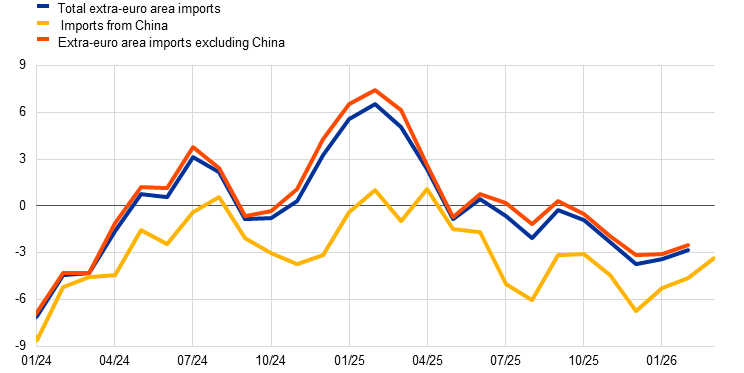
Source: Eurostat.
Note: The latest observations are for February 2026 for total extra-euro area imports and extra-euro area imports excluding China and March 2026 for imports from China.
Euro area consumer goods heavily reliant on imports from China have recently shown relatively subdued price dynamics. This subdued trend is reflected in an NEIG sub-index that focuses on items with a relatively high exposure to imports from China, i.e. items with an above-the-median share of import content from China. Inflation in these China-exposed goods has consistently been lower than total goods inflation, in contrast to the higher inflation dynamics observed in the NEIG sub-index that captures goods with a low exposure to China (Chart B, panel a). In 2025, items for which the share of imports from China increased, such as bicycles, tools, appliances, furniture, textiles, and information and communication technology goods, experienced particularly pronounced declines in import prices. These items (yellow dots in Chart B, panel b) recorded, on average, lower inflation rates compared with other goods, and in most cases, their inflation rates remained below their historical averages. However, across goods categories, there is no clear-cut contemporaneous correlation between the growth in the prices of imports from China and NEIG inflation, likely due to frictions such as delayed exchange rate effects, margin adjustments, regulated prices and demand rigidities affecting product markets in different ways. To account for this heterogeneity, the analysis adopts a granular, item-by-item approach, modelling the goods inflation rate of each NEIG item separately.
Chart B
Nexus of euro area goods inflation and imports from China
a) NEIG inflation and items with a high exposure to China
(annual growth rates)

b) NEIG inflation, import shares and import price inflation
(percentages)
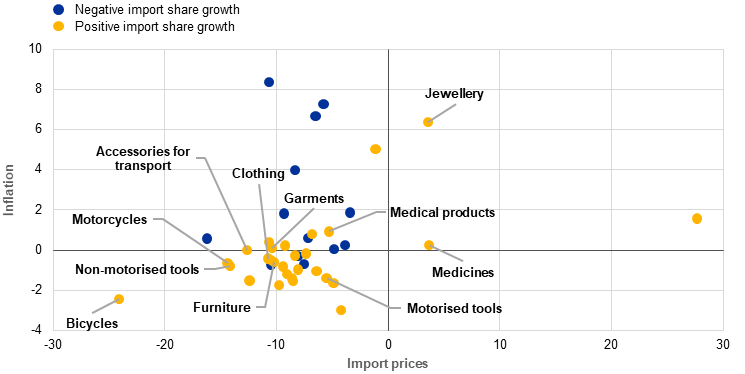
Sources: Panel a): Eurostat, Trade Data Monitor and ECB calculations. Panel b): Trade Data Monitor, Eurostat and ECB calculations.
Notes: Panel a): The NEIG sub-indexes are the weighted sum of goods inflation in those items with either a high or low import exposure to China (above/below median) respectively. The latest observations are for April 2026. Panel b): Both axes show the year-on-year deviation from the long-term, pre-pandemic trend. The chart includes all items corresponding to NEIG inflation, with the exception of the water supply, for which there are no imports. The changes to the import share from China are computed based on the last 12 months as compared with 2023. The latest observations are for May 2026 (flash estimate) for NEIG inflation, April 2026 for the NEIG sub-indices and February 2026 for import shares and import prices.
Empirical evidence indicates that the pass-through of import prices from China is very heterogeneous across the items included in NEIG inflation. A Bayesian Vector Autoregression model is used for 39 NEIG items for which data on prices of imports from China are available and the model identifies sector-specific import price shocks for the corresponding NEIG items.[2] Sectors are classified as “China-sensitive” where NEIG inflation rates respond significantly to such shocks. Of 39 goods items, Figure A illustrates the effects for 21 goods items that respond significantly to import price shocks from China, which explain around half of the total NEIG basket, based on the HICP weights for 2026. Our results suggest that a 10% drop in the growth of sector-level prices of imports from China is associated with a peak effect of a 0.1-0.7 percentage point decline in goods inflation in the most sensitive sectors (underlined items in Figure A), i.e. furniture, small electric appliances, household textiles, glassware and tableware, and major electric appliances. Many of these are items with a relatively high exposure to import content from China. However, there are other items with a lower exposure that are also sensitive to import price shocks from China, suggesting that euro area pricing could be influenced by China through indirect channels, such as lower prices via trade redirection from other countries, or through stronger competition from Chinese producers in global markets. The upper end of these estimates is broadly in line with a rough estimate of the impact of import price developments in China given the import share of China in the NEIG basket, and, assuming full pass-through.[3] The speed of adjustment varies across items, with responses building up gradually and with the strongest negative impact reached after between 9 and18 months.
Figure A
Heatmap of impulse responses of NEIG items sensitive to granular import price shocks from China
(percentage points)

Sources: ECB staff calculations, Eurostat, Statistical Data Warehouse, Trade Data Monitor, Baumeister et al. (2022) for the indicator of global economic conditions.
Notes: The heatmap shows the median impulse responses of NEIG items sensitive to import price shocks from China in the same NEIG item sector, up to the three-year horizon. The responses are normalised to a 1% decrease in the import price year-on-year inflation of the corresponding NEIG item. Negative numbers are portrayed in the blue scale and non-significant segments of the impulse responses are shown in grey, based on the 68% credibility bands. Items with a high import content from China are underlined.
Estimates of the impact of import price shocks from China implied by this granular analysis point to an increasingly negative, albeit contained, contribution to NEIG inflation in 2025 and early 2026. The historical decomposition of total NEIG inflation is constructed by aggregating the estimated impact of such import price shocks on individual goods inflation and applying HICP weights. The estimated effect of import price shocks from China has been persistently negative and seems to have supported the decline in NEIG inflation in the second half of 2025 and the first quarter of 2026 (Chart C). This is consistent with prices of imports from China remaining below those from other countries and with China-exposed NEIG items recording negative inflation for most of 2025 (Charts A and B). The historical decomposition shows that import price shocks from China reduced NEIG inflation by around 0.27 percentage points in April 2026.[4] By contrast, these shocks made a modest positive contribution of around 0.01 percentage points in January 2024.[5] One caveat of this exercise is that import price shocks from China may partly reflect exchange rate movements. The model moderates this measurement risk by positioning the USD/EUR exchange rate before prices of imports from China in the model, therefore import price changes linked to US dollar movements are captured first by the specific exchange rate shock. This is important, because a large share of euro area imports from China are invoiced in US dollars. The estimated exchange rate shock should absorb the exchange rate effects stemming from USD/EUR movements. The remaining import price shock from China therefore captures price changes that cannot be explained by exchange rate movements.[6]
Chart C
Historical decomposition of total NEIG inflation
(annual percentage changes, percentage point contribution in deviation from the mean and initial conditions)
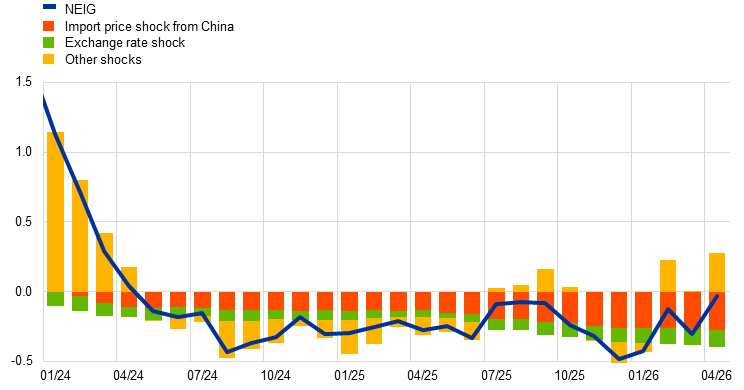
Source: ECB staff calculations based on granular Bayesian Vector Autoregression models for NEIG components.
Note: The latest observations are for April 2026.
Overall, prices of imports from China remain an important source of external price pressures for the euro area, even if their estimated effect on consumer goods inflation is limited. Such import prices have increasingly dampened NEIG inflation, especially since 2025. Several factors suggest that this disinflationary pressure could persist. Prices of imports from China could remain relatively subdued because of persistent excess capacity, weak domestic demand and the depreciation of the renminbi. Some redirection of Chinese exports away from the United States may also persist, potentially increasing the supply of Chinese goods to other markets, including the euro area. However, there are emerging signs of upward pressure from higher oil prices and higher producer prices in China, which could support some reflation.
References
Al-Haschimi, A., Dvořáková, N., Le Roux, J. and Spital, T. (2025), “China’s growing trade surplus: why exports are surging as imports stall”, Economic Bulletin, Issue 7, ECB.
Baumeister, C., Korobilis, D. and Lee, T. K. (2022), “Energy Markets and Global Economic Conditions”, The Review of Economics and Statistics, 104(4), pp. 828-848.
Boeckelmann, L., Emter, L., Gunnella, V., Klieber K. and Spital T. (2025), “China-US trade tensions could bring more Chinese exports and lower prices to Europe”, The ECB blog, ECB, 30 July.
Di Sano, M., Pongetti, G., Schuler, T. and Toh, S. G. (2023), “Spillovers to the euro area from recent negative inflation in China”, Economic Bulletin, Issue 7, ECB.
Legal Disclaimer:
EIN Presswire provides this news content "as is" without warranty of any kind. We do not accept any responsibility or liability for the accuracy, content, images, videos, licenses, completeness, legality, or reliability of the information contained in this article. If you have any complaints or copyright issues related to this article, kindly contact the author above.
