

Japan BESS Market Surges as Energy Vault's 850 MW Entry Fuels Grid-Scale Buildout
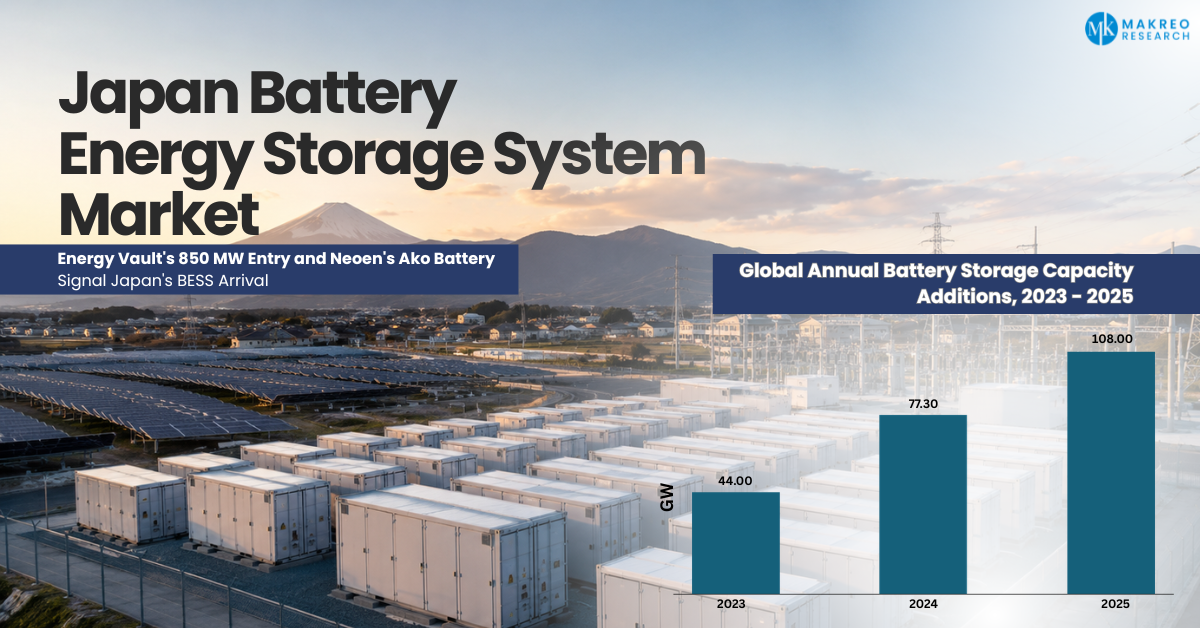
Japan BESS Market Surges With 850 MW Energy Vault Entry, Global Developers Drive Grid-Scale Buildout

Japan's BESS market gains momentum as Energy Vault, Neoen, Itochu, PowerX and Trina Storage scale utility projects amid grid and solar pressure.

Japan's BESS market gains momentum as Energy Vault, Neoen, Itochu, PowerX and Trina Storage scale utility projects amid grid and solar pressure.
The acceleration comes as renewable energy penetration rises, solar curtailment becomes more visible in high-generation regions, and grid connection queues test how quickly standalone BESS capacity can move from applications to operating assets. For investors, developers and suppliers, Japan is shifting from a watchlist market to a strategy-led deployment opportunity.
According to Makreo Research's Global Battery Energy Storage System (BESS) Market and Forecast to 2031 report, global BESS revenue is projected to climb from nearly USD 38.28 billion in 2023 to approximately USD 87.04 billion in 2026, a CAGR of roughly 31.5%, with global stationary storage deployment excluding pumped hydro forecast to rise nearly 33% to close to 122.5 GW this year. Asia Pacific markets, led by China, are increasingly joined by fast-emerging economies such as Japan and Australia.
International Developers Build Larger Japan BESS Pipelines -
Energy Vault has completed its entry into Japan through the acquisition of an 850 MW BESS portfolio from BayWa r.e., including 350 MW of advanced-stage projects and 500 MW of early-stage projects. The advanced-stage assets are expected to begin construction in the second half of 2027 and enter commercial operation in 2028.
Neoen is also entering Japan with the 100 MW/400 MWh Ako Battery in Hyogo Prefecture, its first large-scale investment in the country. The project is being developed with Equans and Toho, supported by a grid connection agreement with Kansai Electric Power Company, and is targeted for commissioning in 2028.
Domestic Players Move From Small Assets to Utility-Scale BESS -
Japan's domestic ecosystem is also scaling. Mitsubishi Estate, Itochu Corporation and Tokyo Century have ordered 230.1 MWh of containerized BESS from PowerX for the Chikuzen Town Energy Storage Station in Fukuoka Prefecture. The project will pair 230.1 MWh of storage with 67 MW of PCS output, use LFP technology assembled in Okayama, and is expected to begin commercial operation in January 2028.
Eku Energy has advanced its fourth Japanese large-scale BESS project with the 30 MW/120 MWh Naganohara project in Gunma Prefecture, while SMFL Mirai Partners and SPARX Green Energy & Technology are co-developing a 23 MW/70 MWh project in Niigata Prefecture. Trina Storage has separately signed a contract for a 160 MWh ultra-high-voltage BESS in Kyushu, scheduled for delivery in 2026 with commercial operation planned in 2027.
Sumitomo Extends Japan Expertise Into Global BESS Platforms -
Energy Global reported that Sumitomo Corporation, through joint venture Summit Transition Partners, has agreed to invest in roughly 694 MW of UK BESS projects developed by Gresham House Energy Storage Fund, building on the battery development and optimization track record Sumitomo built in Japan through subsidiary OPTECH Energy. The move signals Japan is becoming an export base for BESS expertise, not just a destination.
Grid Bottlenecks Create the Next Japan BESS Opportunity -
Japan's BESS market is being shaped by a clear gap between investor appetite and connected capacity. IEEFA analysis cited in recent market coverage shows physically connected BESS capacity at only 0.62 GW, despite a far larger grid application pipeline. METI subsidies, Tokyo Metropolitan Government incentives and the 2022 classification of BESS projects above 10 MW as power generation businesses have improved market participation, but grid connection timing, site control, charging capacity allocation and evolving auction rules remain decisive bankability factors.
The Long-Term Decarbonization Auction is strengthening the investment case by offering fixed 20-year revenue contracts for low-carbon capacity. Hexa Energy Services has brought online the 30 MW/130 MWh Tagawa BESS in Kyushu, described as Japan's first operational BESS with a capacity market contract. In the FY2023 LTDA round, 1.1 GW of BESS was successful, followed by 1.3 GW awarded to 25 BESS projects in FY2024.
Solar Growth Reinforces Japan's Storage Requirement -
Japan added an estimated 5.8 GW to 6 GW of solar in 2025, likely lifting cumulative solar capacity beyond 100 GW. Under Japan's Seventh Strategic Energy Plan, renewables are targeted to account for 40% to 50% of electricity generation by 2040, with solar positioned as the largest power source. This reinforces the long-term need for BESS across energy shifting, curtailment reduction, frequency control, balancing markets and capacity adequacy.
China Dependence Remains a Strategic Question for Developers -
Makreo Research notes that lithium-ion batteries continue to dominate the global BESS market, while lead-acid batteries retain relevance in selected backup power applications. However, global BESS developers remain highly dependent on China due to cost advantage, technology leadership, cell manufacturing scale, export infrastructure and logistics depth. For Japan, this creates a dual priority: secure competitive battery supply while developing local integration, safety, software, procurement and asset optimization capabilities.
Battery Energy Storage System Market Intelligence by Makreo Research -
Makreo has published its Global Battery Energy Storage System (BESS) Market and Forecast to 2031 report, which provides a comprehensive assessment of the global battery storage ecosystem. The study covers detailed market sizing, forecast analysis, battery chemistry segmentation, application outlook, energy capacity trends, ownership models, component analysis, and regional market performance. The report provides regional-level segmentation across Asia Pacific, North America, Europe, Latin America and Middle East and Africa, with detailed case studies on the United States, Australia and Germany. For company-specific or country-specific requirements such as a dedicated Japan BESS market assessment, Makreo's Custom Research and Market Survey services provide tailored, deep-dive analysis.
We also support energy storage, renewables and BESS companies through Custom Research, Market Survey, market entry assessment, competitive benchmarking, and regulatory analysis.
Related Reports:
India Battery Energy Storage System (BESS) Market and Forecast to 2032
For tailored insights or specific inquiries, explore our comprehensive Energy and Utilities Reports
Saurabh Adsule
Makreo Research and Consulting
+91 96196 99069
email us here
Visit us on social media:
LinkedIn
X
Other
Legal Disclaimer:
EIN Presswire provides this news content "as is" without warranty of any kind. We do not accept any responsibility or liability for the accuracy, content, images, videos, licenses, completeness, legality, or reliability of the information contained in this article. If you have any complaints or copyright issues related to this article, kindly contact the author above.
