

Building resilience: how energy prices boost home efficiency
5 August 2026
By Desislava Rusinova and Marco Weissler
High energy prices have sparked new interest in energy-related renovations and non-fossil heating systems. This blog post argues that such investments cushion the impact of energy shocks on the building and construction sector.
When energy prices skyrocket, that often comes as a heavy blow to the real estate and construction sector. Construction and building maintenance costs rise, and mortgages often become harder to arrange and come with higher rates. But for many people, it’s also a moment to rethink, renovate and invest in energy efficiency. So while energy shocks may slow new construction, they can simultaneously drive a wave of renovation activity.
We argue that the energy price surges in 2022 and 2026 have been driving demand for investment in energy efficiency. The recent wave of renovation has also been supported by declining equipment costs and government subsidies. In the shorter term the additional renovation spending can cushion the negative impact of higher energy prices on housing investment. In the longer term it reduces the dependence of the building sector on fossil fuels, increasing its resilience to energy-driven price and confidence shocks.
Renovation wave drives building production
Investment in housing involves not only the construction of new buildings, but also finishing and installation work – so-called specialised construction activities (SCAs). In fact, SCAs represent 75% of construction activity. Energy-related renovations are a large part of SCAs.[1] Electrical, plumbing, heating and air conditioning installations alone accounted for 40% of value added in the five largest euro area countries in 2023. Recently, renovations of existing buildings have been a main driver of the recovery in construction activity. Meanwhile, the construction of new buildings continues to decline – potentially also due to the strong increase in prices for energy-intensive inputs like concrete (Chart 1).[2]
Chart 1
Construction production and prices
(Index, Q1 2022 = 100)

Source: Eurostat Short-term Business Statistics (STBS).
Notes: Composite building production is defined as the output-weighted average of the output of specialised construction activities and construction of buildings. The latest observation is for April 2026.
Household demand is fuelling an energy efficiency-related renovation wave
Efficiency-enhancing renovations comprise a wide range of activities, including the installation of heat pumps, photovoltaic (PV) panels and other heating systems with better energy efficiency, as well as installing or improving building insulation. These activities have become more widespread in recent years.
Chart 2
Households’ interest in energy efficiency-related renovations
|
a) Photovoltaic imports from China (quantity in thousand tonnes, price in EUR thousands) |
b) Funding requests for renovation activities in Germany (number in thousands) |
|
|
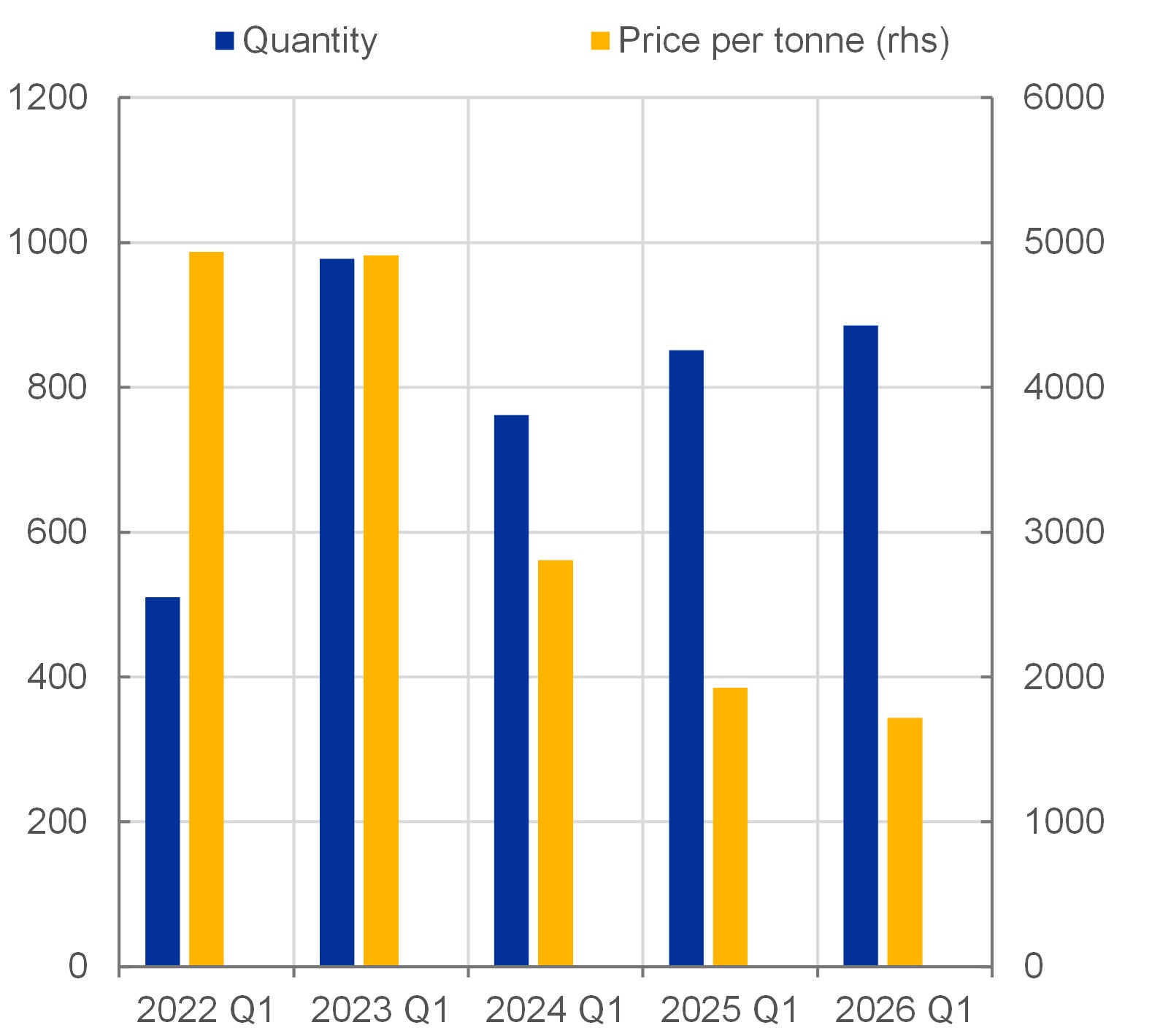
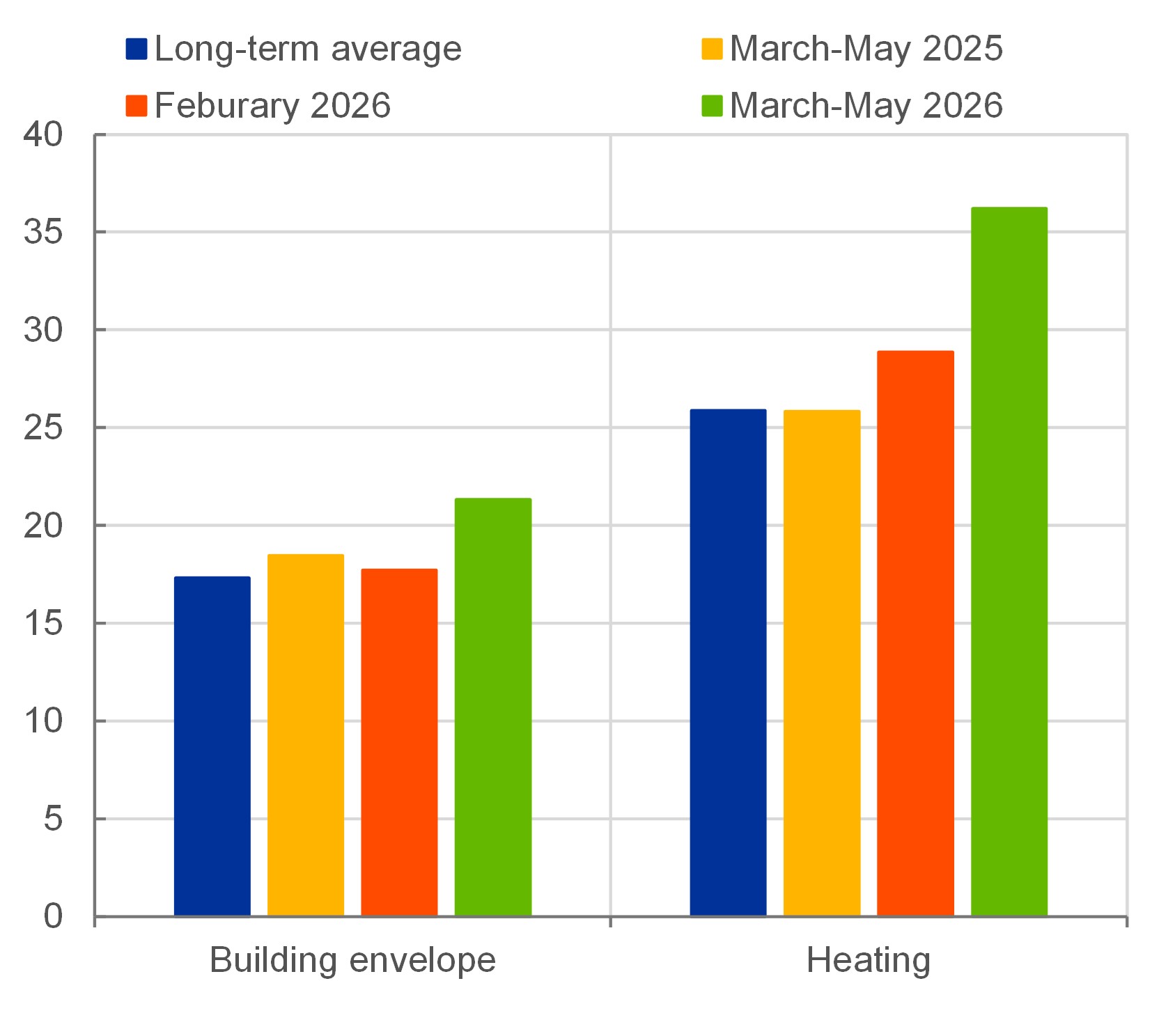
Sources: Eurostat International trade in goods statistics (ITGS), the German Federal Ministry for Economic Affairs and Energy (BMWE) and the German Federal Office for Economic Affairs and Export Control (BAFA).
Notes: Concerning panel a) China is the main supplier of PV modules and panels to the euro area. Its import share stood at 97% or 95% in 2025 in terms of volumes and value, respectively. In panel b) the building envelope includes for instance the insulation or windows. The long-term average is calculated for the period between June 2024 and February 2026. The latest observation is for March 2026 (ITGS) and May 2026 (BMWE/BAFA).
In 2022 PV imports to the euro area increased sharply after the spike in energy prices due to the war in Ukraine. PV imports from China nearly doubled after the energy price hike and have remained high since then (Chart 2, panel a).[3] The decline in their prices since 2023 has likely supported this development. The average price of an imported tonne of PV modules or panels fell by two-thirds – from nearly €5,000 in 2023 to only €1,700 in 2026.
More recently, since the beginning of the war in the Middle East, national subsidy programmes have seen additional demand for financing energy-saving measures, e.g. in the Netherlands or the United Kingdom. In Germany, 64,000 households and businesses sought funding between March and May 2026 to renovate their building envelope – 16% more than in the same period a year earlier. The building envelope includes, for instance, insulation and windows. Funding requests for heating investments increased by as much as 40% (Chart 2, panel b).
Who renovates more?
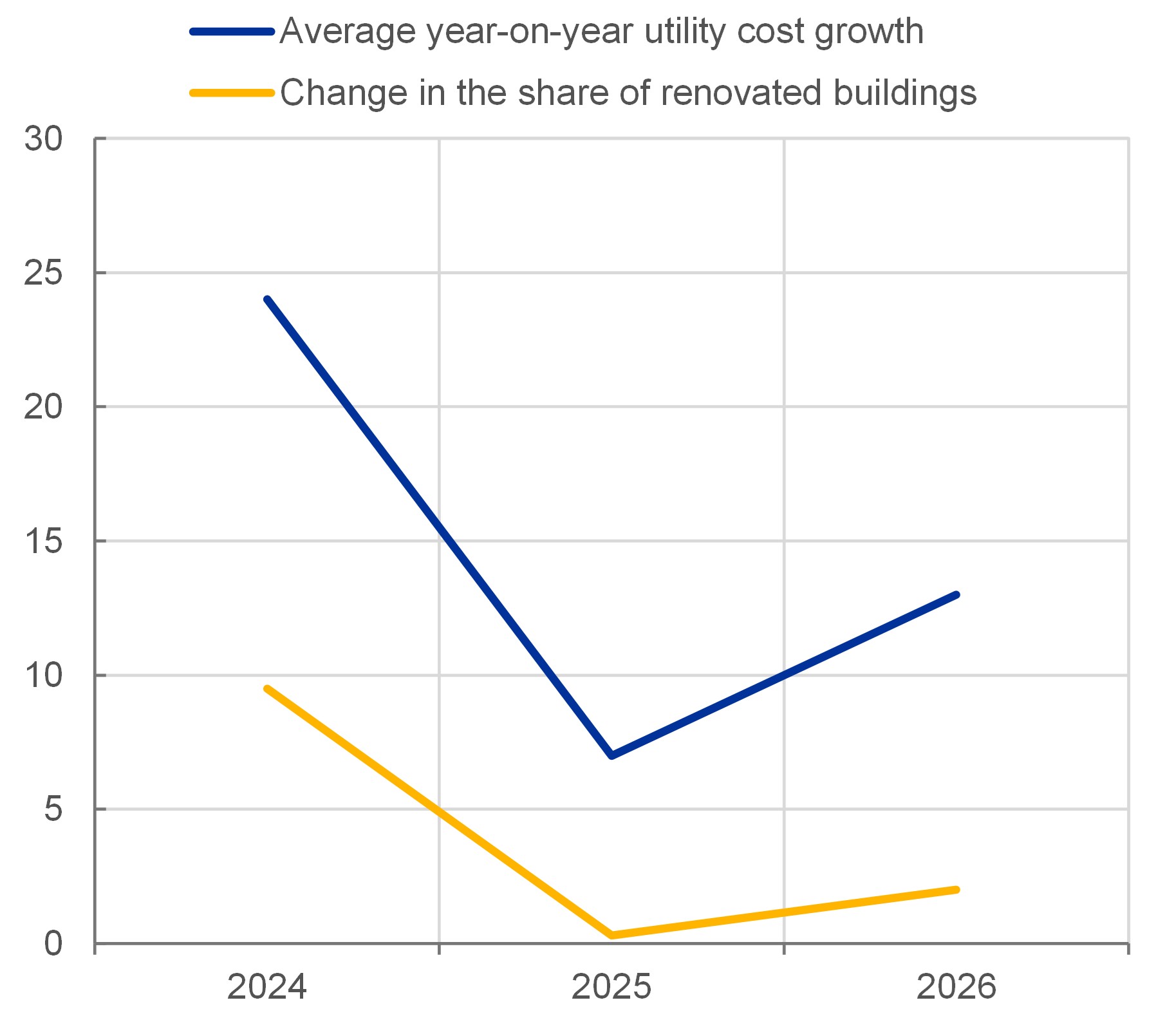
Households who have faced higher heating costs or are more exposed to fossil fuels renovate more. Utility costs are a likely driver of such renovations. Recent results of the ECB’s Consumer Expectations Survey (CES) show that when utility costs grew faster, more households opted for energy-efficiency renovations (Chart 3, panel a).[4] In 2024 and 2026, after reported utility costs in the preceding heating season had grown strongly, the share of energy-renovated dwellings increased notably as well. In the period closest to the Ukraine war, between February 2023 and 2024, this share jumped by 10 percentage points.
Chart 3
Actual and planned household investments in energy-efficiency renovations
|
a) Heating-season utility cost growth and renovations (percentage change; difference in percentage shares) |
b) Probability of planning energy-efficiency renovations relative to households with electric heating (percentage points) |
 |
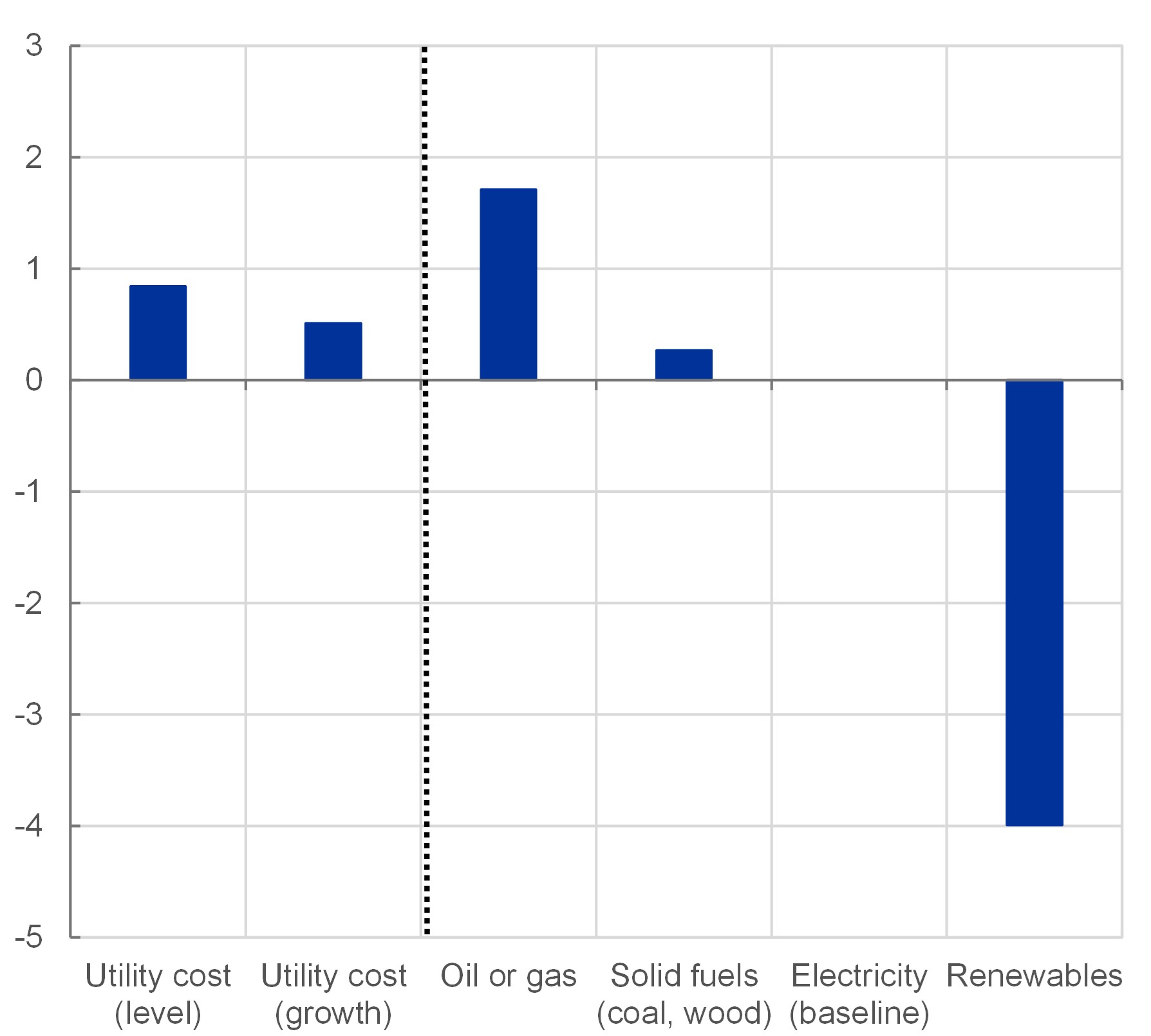 |
Source: ECB Consumer Expectations Survey (CES).
Notes: In panel a) the blue line shows the average year-on-year percentage growth in reported utility costs over the heating season (October to January) preceding the date shown on the x-axis. The yellow line shows the year-on-year change in shares of households reporting that their dwellings have been renovated to improve energy-efficiency. The aggregation is based on the whole sample for which the respective data is available, i.e. there are some sample differences across the time periods. Panel b) shows the probability of planning energy-efficiency renovations during the next 12 months. The bars show regression coefficients controlling for ownership status, property type, property age, past energy renovations and wave fixed and region fixed effects. This estimation is done at the individual household level using the panel structure of the CES. The coefficients are for utility cost level in EUR hundreds in January or April of the preceding year and for utility bill growth in logarithmic year-on-year growth in the same year as the renovation plans. The coefficients for utility cost (level), oil or gas and renewables are significant at the 5% level for standard errors clustered at the individual level. A €100 increase in monthly utility costs is related to a 0.8 percentage point higher renovation probability, a 1.7 percentage point higher probability of using oil or gas heating and a 4.0 percentage point lower probability of relying on renewable heating systems. The latest observations are for February 2026.
Households facing higher expenditure on utilities in recent heating periods are also more likely to plan energy-efficiency renovations of their property. CES data from February 2026 showed that, besides general repairs, energy-efficiency renovations were the most frequently mentioned type of renovation planned. Such plans were mentioned by 14.5% of CES respondents.[5] Households with high utility costs and relying on fossil fuel-based heating systems much more frequently reported that they plan an efficiency renovation (Chart 3, panel b). In contrast, the probability was lower for households with heating systems that rely on renewable energy sources (e.g. heat pumps or solar collectors), which were not affected by the recent price spikes.[6]
Investment increases resilience to energy-price shocks
Beyond cushioning the negative impact of energy price shocks on the building sector, energy-efficiency investments can also make the building sector more resilient to energy price shocks. Following the recent price surges, the share of fossil fuels used for space heating in the euro area declined by 3.5 percentage points between 2023 and 2026 to stand at 56% (Chart 4). Most countries have decreased their reliance on fossil fuels, and those with higher dependence have reduced it by more. Accordingly, households living in energy-renovated housing report lower growth in their utility costs in the subsequent heating season compared with those living in unrenovated homes.[7]
Chart 4
Share of oil or gas heating in 2026 (x-axis) and change in share since 2023 (y-axis)
(horizontal axis: percent ; vertical axis: percentage points)

Source: ECB Consumer Expectations Survey (CES).
Notes: The dashed line marks the linear trendline. The latest observations are for February 2026.
This suggests that energy-efficiency renovations allow households to become more resilient to future energy price shocks, simply because they consume less energy. EU policies are aiming to boost this trend. The European Green Deal aims to at least double the annual rate of energy renovations by 2030.[8] One element of this is the extension of the EU Emission Trading System (EU ETS). The EU ETS increases the costs of CO2 emissions and makes oil and gas more expensive. From 2028, the building sector will also be covered by the EU ETS. And that should further increase the incentives to move away from oil and gas-based heating systems. This has positive implications for monetary policy – both improved energy efficiency and lower reliance on oil and gas heating reduce the impact of oil price fluctuations on inflation.
The views expressed in each blog entry are those of the author(s) and do not necessarily represent the views of the European Central Bank and the Eurosystem.
Check out The ECB Blog and subscribe for future posts.
For topics relating to banking supervision, why not have a look at The Supervision Blog?
Legal Disclaimer:
EIN Presswire provides this news content "as is" without warranty of any kind. We do not accept any responsibility or liability for the accuracy, content, images, videos, licenses, completeness, legality, or reliability of the information contained in this article. If you have any complaints or copyright issues related to this article, kindly contact the author above.
